
Assetto Corsa EVO 0.7: Modding Tools, a New Safety Rating, and Why This Update Changes Everything
Kunos Simulazioni dropped Update 0.7 for Assetto Corsa EVO on June 3rd, and this one deserves more attention than it's getting. Beneath the headline additions — four new cars, a revamped particle system — sits the feature that the sim racing community has been waiting for since Early Access launched in January 2025: the first official release of the Assetto Corsa EVO SDK. Modding is back, and so is the ecosystem that made the original Assetto Corsa one of the most enduring platforms in sim racing history. Alongside it, a completely rethought safety rating system is rewriting the rules of online competition.
Let's break down what's new, what it means, and why it matters for anyone running a serious sim rig.
The SDK Is Here — And It's Built on the Same Pipeline Kunos Uses
The original Assetto Corsa became a legend in large part because of its modding community. Thousands of community-built cars and tracks transformed it from a focused sim into a sprawling platform that could replicate virtually anything with four wheels. With EVO, Kunos took a different approach during Early Access — locked down, polished, and controlled. That era is officially over.
The Assetto Corsa EVO SDK app ships with Update 0.7, and it's not a simplified toy. The production pipeline reportedly mirrors the same technologies and workflows Kunos uses internally to build their own content. That means community creators aren't working with a dumbed-down subset of tools — they're getting access to the real thing, or something very close to it.
At launch, the SDK focuses exclusively on vehicle creation. Technically skilled modders can build and import custom cars for use in single-player modes. Track modding, custom liveries, and multiplayer mod support are all on Kunos's roadmap, with the studio describing this release as "the beginning of a long-term vision for a more open and expandable platform."
For sim racers running high-fidelity setups, this matters enormously. The original AC's modding scene produced some of the most accurate car physics recreations available anywhere — community-built GT3 and GT4 cars that rivaled and sometimes surpassed official content. If EVO's SDK delivers on its promise, we're looking at a future where the car list is essentially limitless and the physics quality keeps climbing as talented creators push the boundaries.
Four New Cars: From Vintage Japanese Metal to Modern GT3 Weaponry
Update 0.7 adds four vehicles that span a wide range of the performance spectrum, and each one brings something distinct to the garage.
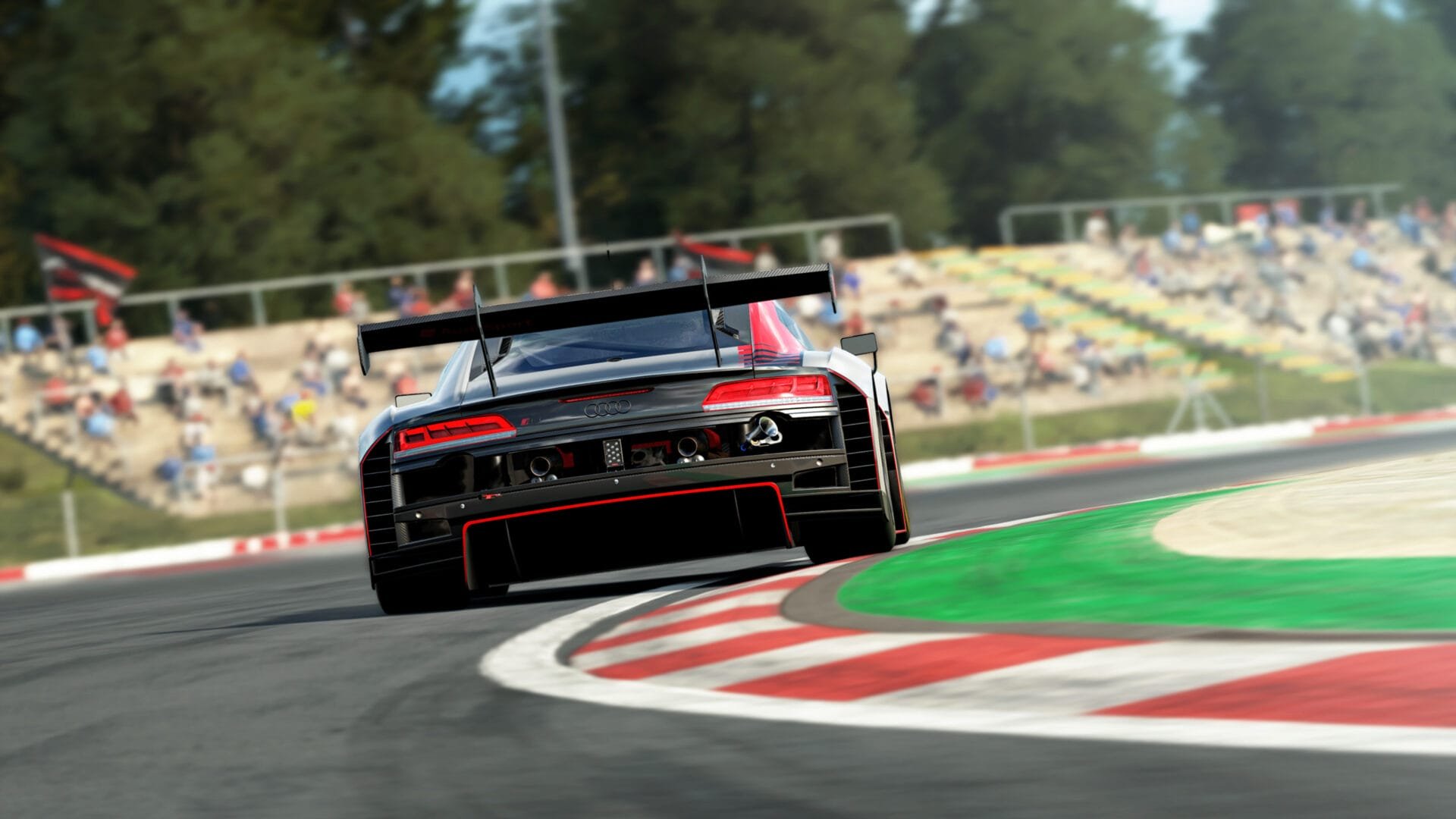
The Audi R8 LMS GT3 Evo II is the headliner for competitive sim racers. As one of the most successful GT3 platforms in real-world endurance racing, the R8 LMS is a car our team knows intimately from countless hours in iRacing endurance events. Having it arrive in EVO with Kunos's latest physics model means another high-quality benchmark for cross-platform comparison — and another reason to fire up EVO alongside iRacing in your training rotation.
The Porsche 935 is a modern tribute machine built on the 911 GT2 RS Clubsport platform, wrapped in the unmistakable long-tail bodywork of the original 1970s icon. It's a car that bridges eras — modern engineering dressed in historic silhouette — and on a high-end direct drive wheelbase, the blend of raw turbo power and aerodynamic downforce should produce some spectacular force feedback sensations.
The Porsche 911 GT2 RS Clubsport Evo Kit rounds out the Porsche contingent. This is the track-weapon version of an already extreme car, and it sits perfectly in the sweet spot that serious sim racers gravitate toward: too fast for public roads, purpose-built for circuit work, and demanding enough to expose every flaw in your technique.
Then there's the Datsun 240Z, available in two variants — one near-stock, the other tuned for sharper cornering dynamics. It's a welcome change of pace from the GT machinery, and the kind of car that rewards smoothness and car control over brute-force speed. On a motion platform with traction loss enabled, a lightweight rear-drive classic like this is where you really feel the difference between a consumer setup and a properly calibrated simulator.
A Particle System That Actually Matters for Immersion
Visual effects in racing sims tend to be an afterthought — nice to look at in replays, largely ignored during competition. EVO's new particle system in 0.7 is trying to change that by tying visual feedback directly to what the car is doing mechanically.
Tire smoke now reacts dynamically to wheelspin, slides, and sustained drifts. It's not a canned animation triggered by a threshold — the intensity and behavior scale with what's actually happening at the contact patch. Dust and dirt kick up appropriately when you leave the racing surface or clip gravel traps. Wet-weather spray responds to speed and proximity. Crashes and contact produce impact effects with genuine visual weight.
Why does this matter on a high-end rig? Because immersion isn't just about force feedback and motion. Your brain integrates visual cues with haptic feedback to build a coherent picture of what the car is doing. When the smoke billowing off a locked rear tire matches the force you're feeling through the wheel rim — when the dirt spray off a gravel excursion coincides with the motion platform's traction loss response — the simulation becomes more than the sum of its parts. On a triple-monitor or ultrawide setup running at high frame rates, these particle improvements close another gap between screen and windshield.
EVO SR: A Safety Rating That Rewards Racing, Not Avoidance
This might be the most quietly revolutionary feature in the entire update. Kunos has deployed a new Safety Rating system — EVO SR — on the official Daily Racing Portal, and it fundamentally rethinks how online behavior is measured and rewarded.
Most sim racers are familiar with iRacing's Safety Rating, which essentially penalizes incidents and rewards clean laps. The unintended consequence is well-known: you can grind your SR by running at the back, far from other cars, accumulating clean corners without ever actually racing anyone. It rewards avoidance as much as skill.
EVO SR takes the opposite approach. The system measures the time you spend racing in close proximity to other cars without contact. Your rating increases when you're wheel-to-wheel and clean — not when you're cruising alone in clean air. Drivers who hang back and avoid engagement won't see their rating climb the way close, hard racers will.
The contact analysis goes deeper than a simple binary. EVO SR analyzes impact points to attribute blame, so victims of aggressive moves aren't unfairly penalized. Severity matters — a light door-to-door brush carries minimal SR impact, while a full-speed punt into Turn 1 hits hard. It's a system designed to reward the kind of racing that makes sim racing worth doing in the first place: close, competitive, and respectful.
For competitive sim racers and endurance teams, this is a significant development. If EVO SR delivers on its design goals, it could create a multiplayer environment where high-rated lobbies consistently produce the kind of racing you'd expect from a well-run league — without the league infrastructure.
What This Means for High-Fidelity Simulator Builds
Assetto Corsa EVO has been on a steady upward trajectory through Early Access, and Update 0.7 represents a inflection point. The SDK release means the content pipeline is about to expand dramatically. The safety rating system signals that competitive multiplayer is being taken seriously. The particle system and ongoing physics refinements continue to raise the baseline fidelity.
For anyone running a premium simulator build, EVO is increasingly earning its place in the software rotation alongside iRacing. Where iRacing excels in organized competition, structured seasons, and the deepest online racing ecosystem in the world, EVO is carving out territory in physics fidelity, visual quality, and now community-driven content expansion.
At Rocky Sim Racing, we run both platforms extensively across our 12-driver e-sports team. Our approach to force feedback profiling — building custom profiles from driving actual customer cars like the Porsche 992 GT3 and Ferrari 296 Challenge — benefits directly from having multiple physics engines to cross-reference against real-world data. When a car feels right in iRacing and right in EVO and right on our D-Box motion platform compared to the actual vehicle, that's when we know the calibration is dialed.
The Audi R8 LMS GT3 Evo II arriving in EVO gives us another direct comparison point. It's the kind of car that shows up across multiple platforms and real-world series, making it invaluable for validating that a simulator build is translating real physics accurately — not just replicating one title's interpretation of them.
Looking Ahead: What's Next for EVO
Kunos has been transparent about their roadmap. Track modding and custom liveries are coming to the SDK. Multiplayer mod support will follow. The full 1.0 release is expected to land by mid-2026, which means the features we're seeing in 0.7 are the foundation, not the ceiling.
For the sim racing community as a whole, the most exciting implication is competition. iRacing has been the undisputed king of organized online sim racing for over a decade. A credible challenger with strong physics, official modding support, and a safety rating that encourages real racing pushes the entire industry forward. When platforms compete on quality, sim racers win.
Whether you're running EVO on a single ultrawide or across triple OLEDs with a full D-Box motion platform underneath you, Update 0.7 is worth installing and exploring. The SDK alone makes this a milestone release — everything else is a bonus.
