
We’ve Been on the Simucube 3 Pro. The Ultimate is Next — and the Bar Has Already Been Set Impossibly High.
If you follow what we do at Rocky Sim Racing, you already know Simucube is a cornerstone of our highest-fidelity builds. The Simucube 2 Ultimate sat at the top of our spec sheet for years, and for good reason. When we started integrating the Simucube 3 Pro into our client rigs and our own competition setup, we were not expecting to be this impressed. We were wrong to underestimate it — and now, with the Simucube 3 Ultimate finally shipping, we expect to be wrong all over again in the best way possible.
Let us tell you what we have experienced on the Pro, why it has recalibrated what we think a direct drive wheel base should feel like, and exactly why the Ultimate’s new motor architecture has us excited.
First: What the Pro Told Us
Before you can understand why we are excited about the Ultimate, you need to understand what time on the Pro revealed.
The detail resolution is in another category. We have run a lot of wheel bases through our builds — Simucube 2, Simagic, Moza, and everything in between — and the SC3 Pro communicates information at the contact patch that earlier hardware simply blurred together. Loading tires through a long corner feels precise. Not just “more force” — precise. You can feel grip building across the tread, catch the moment a tire starts to give up traction, and sense the weight shifting corner to corner the way a real car communicates it through the rim.
The tuning software — Tuner 3.0 — is nothing short of remarkable. The level of detail you can adjust is deep without being intimidating, and Simucube has done serious work making the interface actually intuitive. You can pre-test how a settings change will feel before you apply it. That alone changes how you build a force feedback profile. No more alt-tabbing, applying a setting, and then doing a lap to figure out if it made things better or worse. You dial it in the smart way. For the kind of on-site tuning sessions we run for our clients — getting a Ferrari Challenge driver or a real-world Porsche Cup competitor dialed into 95% realism — this software is a game changer.
The Control Box is another one of those features that sounds minor until you live with it. Mid-session, if the car transitions to a different compound feel or the track rubbers in, you reach over, dial the torque or damping down a notch, and keep driving. You never leave the cockpit flow. For a 12-hour endurance stint on iRacing, that operational control matters more than you might think.
Dan Suzuki — one of the most analytically rigorous voices in sim racing content — reviewed the Pro and called the force feedback cleaner, more controlled, and more polished than anything Simucube has produced before. We agree. And his assessment of the direction Simucube is taking — building a platform rather than just a wheel base — is exactly the point. The SC3 is a foundation, and the Ultimate is what that foundation was built for.
The New Motor: Why the Ultimate is Different
The Simucube 3 Sport and Pro use highly refined conventional motor designs. The Ultimate does something different entirely. It uses a Spoke-type Internal Permanent Magnet (IPM) motor, and if that sounds like marketing language, let us explain why it is not.
A spoke-type IPM concentrates magnetic flux inside the motor in a fundamentally different way than the surface-mounted permanent magnet design that has powered most direct drive wheel bases — including the Simucube 2 Ultimate — for years. The magnetic field is denser, the torque delivery is faster, and critically, the whole system is more thermally efficient. You get 35Nm of peak torque while pulling the same 450W of peak power as the Pro at 25Nm. That is an engineering story worth paying attention to.
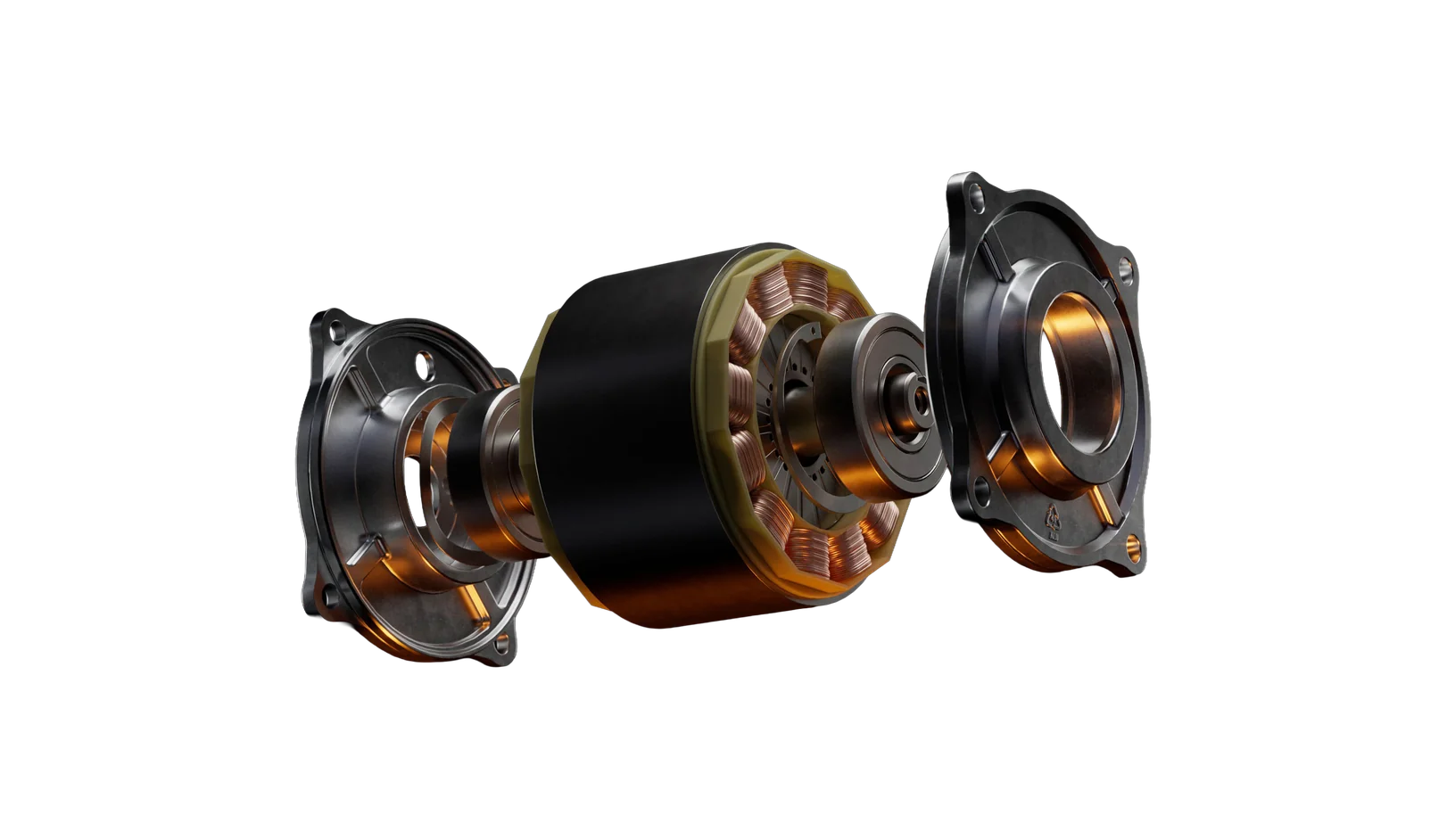
In sim racing terms, thermal efficiency means something very specific: consistency across a long stint. If you have ever felt a wheel base get slightly softer after forty minutes of endurance driving, you know thermal throttling. The Spoke IPM architecture largely eliminates that. The base you feel in lap one is the base you feel in lap forty — and in hour six if you are deep in a 24-hour endurance race.
The response speed increase from the new motor also matters at the limit. Self-aligning torque when the car rotates, the snap of understeer finding grip again, the precise moment weight unloads over a kerb — all of these events happen in milliseconds. A faster transient response motor communicates them more faithfully. On the Pro, this is already meaningfully better than the SC2. On the Ultimate with the Spoke IPM, it pushes further again.
Every Simucube 3 Ultimate also receives individual laser calibration at the factory. Each unit’s motor is physically measured — magnet placement, rotor balance, winding geometry — and that data is built into a digital twin model that the control loop operates against. Your wheel base is not calibrated to a generic reference; it is calibrated to itself. The result, according to Simucube, is the sharpest detail they have ever produced. Based on what we felt on the Pro, we have no reason to doubt that claim about the Ultimate.
LightBridge and the Platform Play
One of the most forward-thinking engineering decisions in the SC3 generation is LightBridge — Simucube’s contactless power and data transfer system embedded in the Quick Release.
There are no pins. No contacts. Power and telemetry pass wirelessly through the QR mechanism, which uses a harmonic polygon locking shape for zero play under load. After thousands of connection cycles, there is nothing to corrode, wear, or introduce resistance. For a turn-key simulator we build for a client who is going to use it seriously for five to ten years, a wear-free QR connection is exactly the kind of engineering detail that separates a professional system from consumer hardware.
The broader Simucube Link ecosystem ties wheel base, ActivePedals, and Simucube-compatible wheels together through an Ethernet-based, galvanically isolated backbone. Brands like Bavarian SimTec, GSI, and Ascher Racing are already building Simucube Link-compatible wheels. The platform grows over time without requiring new cabling or adapters. This is the kind of long-view infrastructure thinking that makes speccing a Simucube 3 Ultimate into a client build an investment that ages well.
As Dan Suzuki noted in his SC3 Pro review, this is where Simucube’s direction gets interesting: the question is not just about force feedback anymore. It is about what ecosystem you are buying into. Our answer for high-end builds is clear.
How This Slots Into a Rocky Sim Racing Build
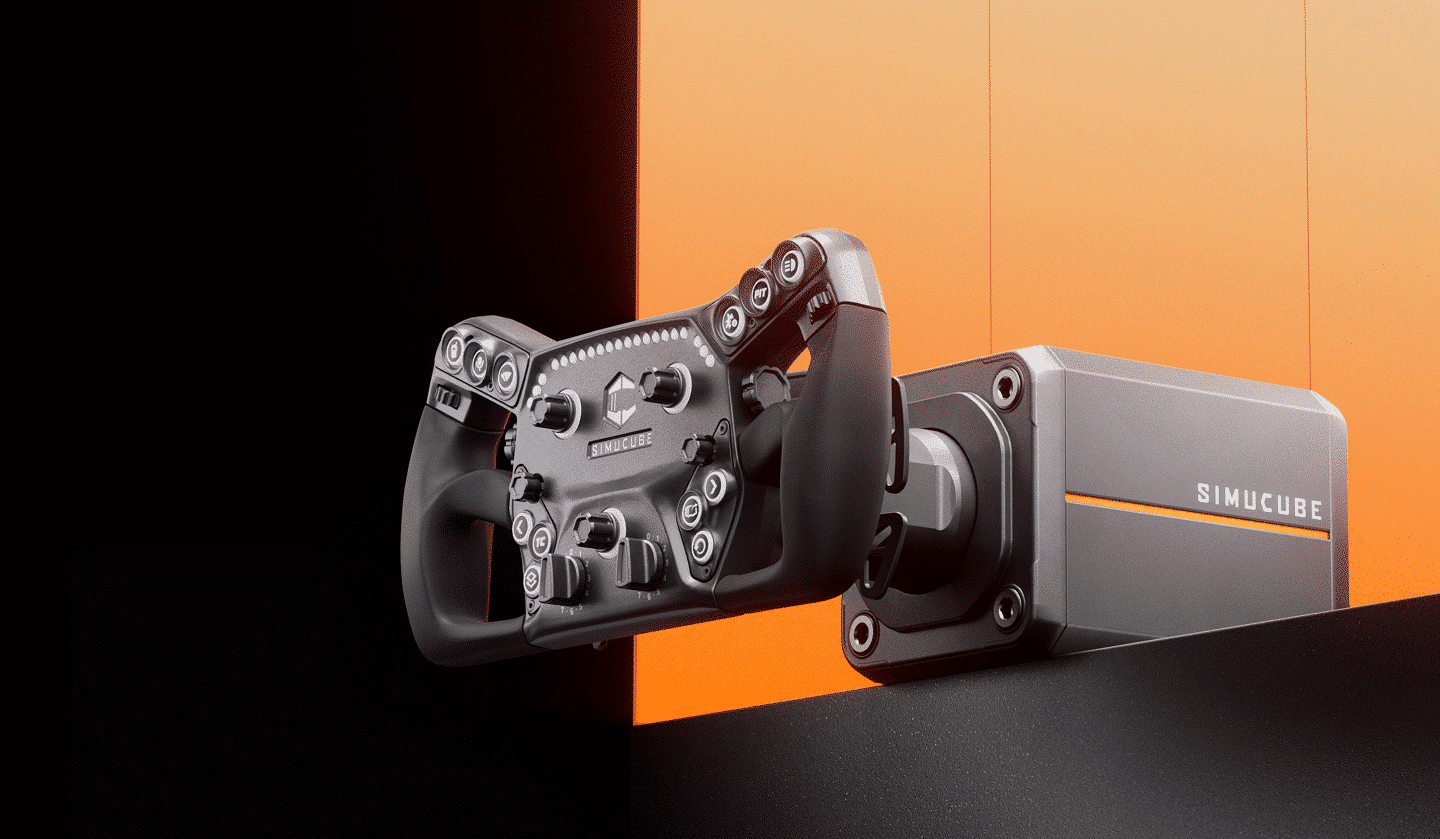
The Simucube 3 Ultimate is the force feedback centerpiece of what we call our Darkest builds — the configurations where every component is chosen without compromise and the target is our 95% real-world fidelity threshold.
Paired with Simucube ActivePedals, a D-Box G5 four-corner motion platform with Traction Loss, triple 45-inch OLED displays on an Advanced SimRacing Pro Chassis, the SC3 Ultimate becomes the communication point for everything happening at the contact patch. Weight transfer. Slip angle. Surface changes. Mechanical grip transitions. All delivered with the immediacy that lets a driver build genuine muscle memory — the kind that translates directly from the sim to the real car at the track.
Part of our iRacing e-sports team — the same drivers who took GTP P1 at the 2026 Sebring 12 Hours and stood on the podium at the Nürburgring 24H — will be among the first to validate the SC3 Ultimate in serious competitive conditions. We will be building custom force feedback profiles through Tuner 3.0 and logging endurance hours to understand how the Spoke IPM motor behaves across the kind of extended stints that stress-test any hardware. Those profiles feed directly into the systems we deliver to customers.
The Verdict — Before We Have Even Turned a Wheel on It
We have set a high bar for what we spec into our builds. The Simucube 3 Pro already raised what we thought possible in direct drive force feedback. The feel is detailed, smooth, and communicative in a way that makes loading tires feel like a precise, readable event rather than a vague sensation. The tuning software is the best in the segment.
The Ultimate takes the same control loop and software foundation and installs a Spoke IPM motor that delivers 35Nm with better thermal consistency, faster transient response, and individual factory calibration. It is, by any reasonable measure, the most capable direct drive wheel base Simucube has ever built — and if the Pro is the benchmark for everything we know, the Ultimate is what we are expecting to exceed it.
If you are building a simulator where the force feedback chain has no ceiling — where the hardware needs to perform over years of serious use, from iRacing endurance sessions to real-world driver training — the Simucube 3 Ultimate is where that conversation starts.
Ready to experience what 35Nm of next-generation force feedback feels like inside a fully integrated Rocky Sim Racing build? Book a free consultation and let us spec a system matched to your driving goals.
